How turning data into meaningful insight can help you thrive in a softening market

Assess the historical performance of the portfolio at a granular, component level. Evaluate how the rating and underwriting mix changes applied in the past have impacted performance. Review and validate modelling assumptions, including robust IBNR provisions. These are the foundations on which we lay the credibility of our forward-looking outlook.
From the insights garnered through stage 1, form an actuarially informed view of how the business being written today is expected to earn out over the current underwriting period. Effectively, understand the rate adequacy of the portfolio by component.
Use the results so far to decide where to grow, maintain, or improve. Define resulting actions that are measurable so you can quantify their impact on GWP, loss ratio, and overall portfolio shape.
As results are earned through, it is fundamental to separate the signal from the noise and look for early divergence from expectations. Incorporate this with the impact of external drivers, e.g. inflation, competitor activity, and adjust quickly to keep the portfolio on track.
A good portfolio management approach will cycle through the steering loop repeatedly, enabling timely and targeted actions to be taken to meet profitability objectives.
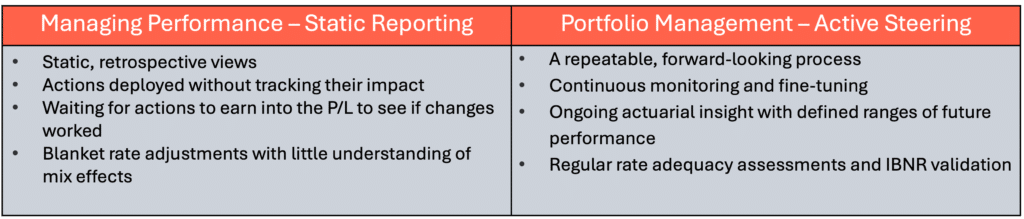
Quite often we see that profitability is assessed in the here and now – a single snapshot of what performance looks like today, usually at a high level. There is little insight into the good (and bad) performing areas of a portfolio, and frequently, we see ‘blanket’ actions followed by a year of waiting to see if they worked.
Steering, through disciplined portfolio management, unlocks valuable insight that simple snapshots miss; it provides us with the clarity to understand:
Let’s say we have a portfolio, currently running at a loss ratio of 48% against a maximum target of 50% at which point this becomes unprofitable for a carrier.
Assuming the carrier is comfortable continuing to write to a 48% loss ratio, this leaves little margin for deterioration in performance and so early identification of any slippage, and swift corrective action is critical.
Steering makes it possible to manage the loss ratio with some certainty; it enables the portfolio to be assessed at a component part and in aggregate, it links actions to expected improvements, and it monitors whether those improvements are actually earning through.
Portfolio management enables us to answer the fundamental questions needed to achieve target performance.
To steer a portfolio effectively and achieve sustainable results, great portfolio management discipline must reflect a continuous cycle of analyse, project, and adjust. Fundamentally, at its core, it should exhibit the following characteristics:
Steering weaves together past, present, and future. It allows us to learn from history, set an informed forward view, act intentionally, and verify that reality is tracking the plan; adjusting fast when it isn’t. That’s what great portfolio management looks like for an MGA and why it should consistently deliver target profitability.